
Key Takeaways
- Missing or slipping slate tiles should never be ignored. Often caused by aging fasteners, even a single displaced slate can expose the roof deck to moisture and lead to more widespread damage.
- Cracked, broken, or delaminating slates are warning signs of deterioration. Damaged tiles allow water intrusion and can accelerate wear on the surrounding roofing system if repairs are delayed.
- Attic moisture and interior staining often point to hidden roof problems. Damp insulation, stained rafters, or water marks may indicate leaks that are not yet visible inside living spaces.
- Failing flashing can compromise an otherwise durable slate roof. Rusted, pitted, or deteriorating flashing around chimneys, valleys, and roof penetrations is a common source of leaks and should be inspected regularly.
- Slate debris accumulating in gutters may signal aging tiles. Excessive stone particles or silt can indicate that slates are becoming porous and breaking down, especially after years of exposure to freeze-thaw cycles.
There is a common myth whispered among homeowners and real estate agents alike: that a slate roof is “indestructible.” It is easy to see why this belief persists. Slate is, after all, a natural stone forged by tectonic pressure over millions of years. While it is true that the stone itself can last for centuries, a roof is a complex system of moving parts, not a solid monolith. Even the finest slate roof is only as strong as its weakest link, which is usually the metal fasteners, the flashing, or the occasional tile that has succumbed to decades of Midwestern weather.
Understanding when to repair a slate roof is the difference between a simple maintenance visit and a catastrophic interior renovation. While the stone remains, the “biological” life of the roof, the copper nails, the lead valleys, and the underlying felt eventually comes to an end. Vigilant care and early detection of signs of slate roof repair are essential to ensuring your home remains a dry sanctuary. In the Greater Chicagoland area and Northwest Indiana, where Lake Effect snow and rapid freeze-thaw cycles put immense stress on masonry, knowing these five signs can save you tens of thousands of dollars in restoration costs.
1. Slipping or Missing Slates (Fastener Failure)
Perhaps the most visible sign of trouble is the appearance of a “gap” in the uniform rows of your roof, or finding a stray piece of slate on your lawn after a storm. This is rarely a failure of the stone itself; rather, it is a failure of the fastener.
Traditionally, slate tiles are held in place by two copper or galvanized nails. Over 70 to 100 years, even copper can wear thin, a phenomenon often called “nail sickness.” When the head of the nail wears away, the slate simply slides down the roof deck. A single missing slate is never just a cosmetic issue. The roof deck beneath that gap is completely unprotected, and if one slate has worked itself free, the nails holding adjacent tiles are likely at a similar stage of deterioration. If you notice even one tile out of alignment or missing entirely, it is a clear sign of slate roof damage in Chicagoland that needs immediate attention before a chain reaction begins.
2. Cracked or “Delaminating” Tiles
Not all slate is created equal. Depending on the quarry it originated from, some slate is “hard” while others are “soft.” Over decades, softer slates may begin to delaminate, a process in which the stone splits into thin, flaky layers.
If you look at your roof and see tiles that appear “shaggy” or have vertical cracks running through them, the stone is reaching the end of its functional life. Cracked slates act like a straw, siphoning water upward through capillary action and depositing it onto your wooden rafters. Identifying these slate roof repair signs early allows a specialist to “slate in” new pieces, replacing only the compromised tiles rather than the entire slope.
3. Internal Attic Moisture or Staining
Sometimes the most telling signs of roof failure aren’t found on the roof at all, but in the attic. During heavy rain or after significant snowmelt, take a flashlight into your attic. Look for dark staining on the rafters, damp insulation, or the “sheen” of water reflecting off the underside of the roof deck.
Because slate is so heavy and dense, a leak often doesn’t manifest as a “drip” in your living room right away. Instead, the water may travel along a rafter for several feet before dropping. If you see white mineral deposits (efflorescence) on the underside of your slates or damp wood, the system has been compromised. This is a primary indicator of when to repair a slate roof to prevent mold growth and structural rot.
4. Rusted or Compromised Copper Flashing
The “valleys” (where two roof planes meet) and the “chimney flashing” (the metal wrapped around the base of your chimney) are the most vulnerable points of any roof. On high-end slate roofs, these are typically made of copper.
While copper is incredibly durable, it eventually thins out due to acid rain and thermal expansion. If you see green streaks on your slate (patina run-off) that appear excessively bright, or visible holes or “pitting” in the metal valleys, the flashing is failing. Water will always find the path of least resistance, and a pinhole in a copper valley can allow gallons of water into your wall cavities during a typical Indiana thunderstorm.
5. Large Deposits of Debris or Silt in Gutters
The next time you clean your gutters, pay close attention to what is inside them. While leaves and twigs are normal, a large amount of “silt” or small, flat stone chips is a warning sign.
As slate ages and weathers, it sheds small particles. An accumulation of stone grit in the gutters suggests that the slates are thinning and becoming porous. When slate becomes porous, it holds onto moisture. When that moisture freezes in the winter, it expands, causing the stone to “spall” or flake further. If your gutters are filling with the remnants of your roof, it’s time for a professional assessment.
The Risk of DIY: Why You Should Never Walk on Slate
When homeowners spot signs that their slate roof needs repair, their first instinct might be to grab a ladder and take a closer look. This is a dangerous mistake for two reasons. First, slate is incredibly slippery, especially when wet or covered in a fine layer of dust or moss.
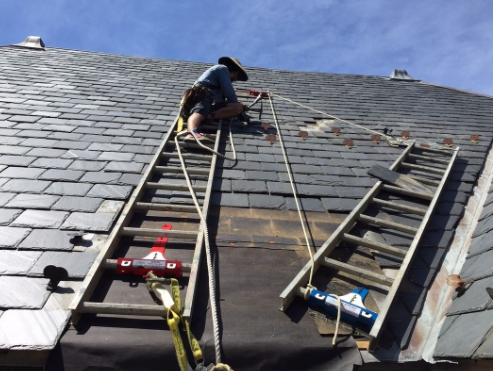
Second, walking on a slate roof, even if you are careful, will almost certainly cause more damage. Slate is designed to shed water, but it is not designed to support the concentrated weight of a human foot. Stepping on the center of a slate tile can snap it instantly, creating three new leaks where there was previously only one. Professional slate masons use specialized “hook ladders” and “roof brackets” to distribute weight and protect the stone’s integrity.
The Todco Difference in Slate Restoration
Restoring a slate roof is an artisan craft that requires a deep understanding of mineralogy, historical architecture, and traditional metalwork. At Todco Roofing, we don’t just “patch” roofs; we restore them. Our team has specialized expertise in identifying the unique nuances of slate roof damage in Chicagoland, from sourcing the perfect color-match stone to performing intricate repairs.
We understand that your slate roof is a historic asset and a significant financial investment. Our goal is to extend the life of that investment through meticulous, honest repair work that respects the original craftsmanship of your home.
Schedule Your Professional Inspection
Don’t wait for a ceiling stain to tell you that your roof is in trouble. Early intervention is the key to preserving a slate roof for another fifty years. If you have noticed any of these slate roof repair signs, or if it has been more than five years since your last professional look-over, contact us today.
We invite homeowners and commercial property managers throughout the Greater Chicagoland area and Northwest Indiana to schedule a professional slate inspection with Todco Roofing. Let our experts provide the cautious, expert care your roof deserves before minor issues become major replacements.